Case study · Good Stewards Church · West Covina, CA · August 2022
Delivered Monday. Worshipping on it Sunday.
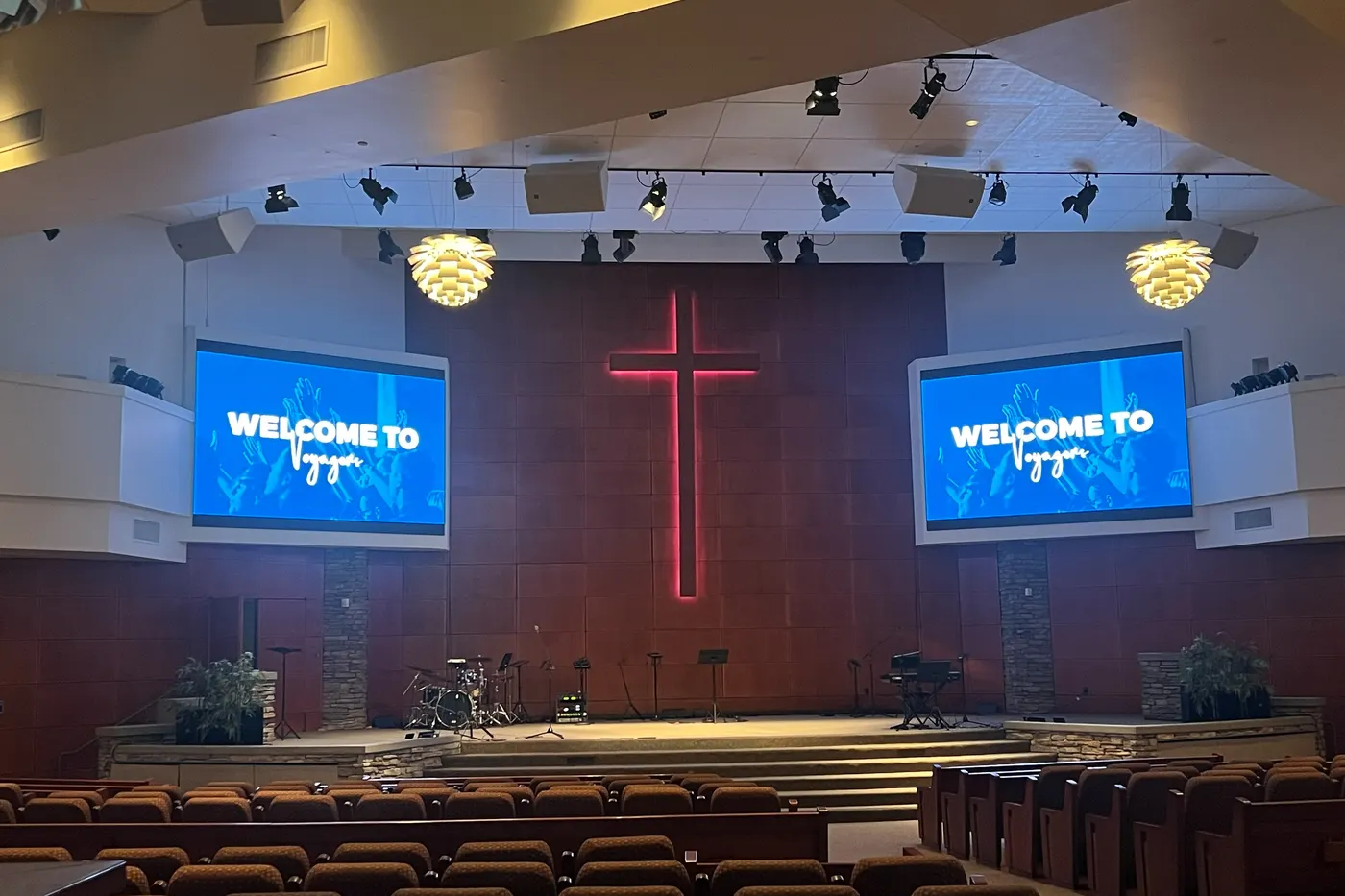
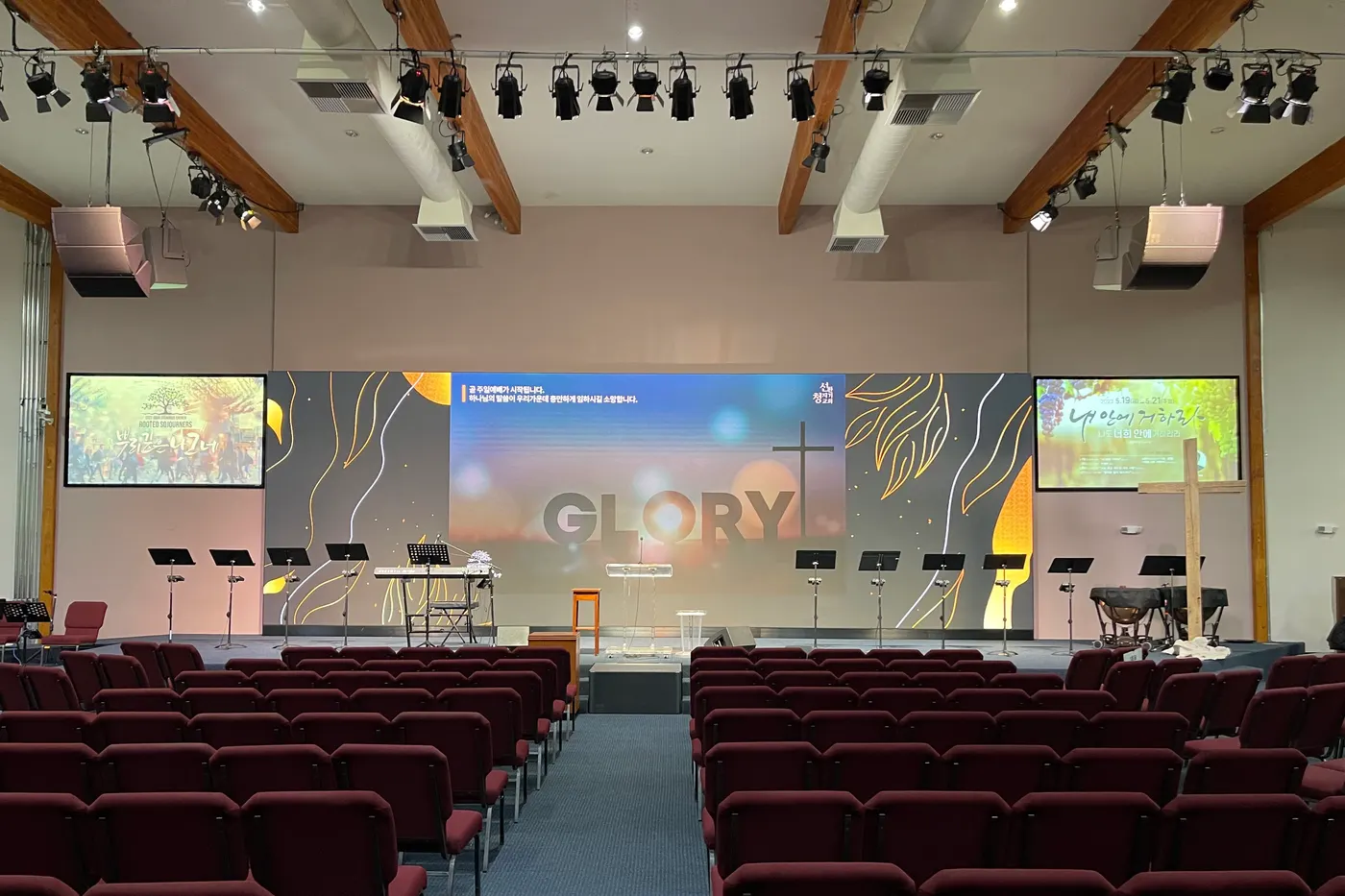
Our first church project: a 38-foot LED wall across the whole stage of a working sanctuary. It was delivered on a Monday, in use for worship that Sunday, and handed over two and a half weeks before the church hosted a hymn competition for its sister churches. The church did not lose a single Sunday.
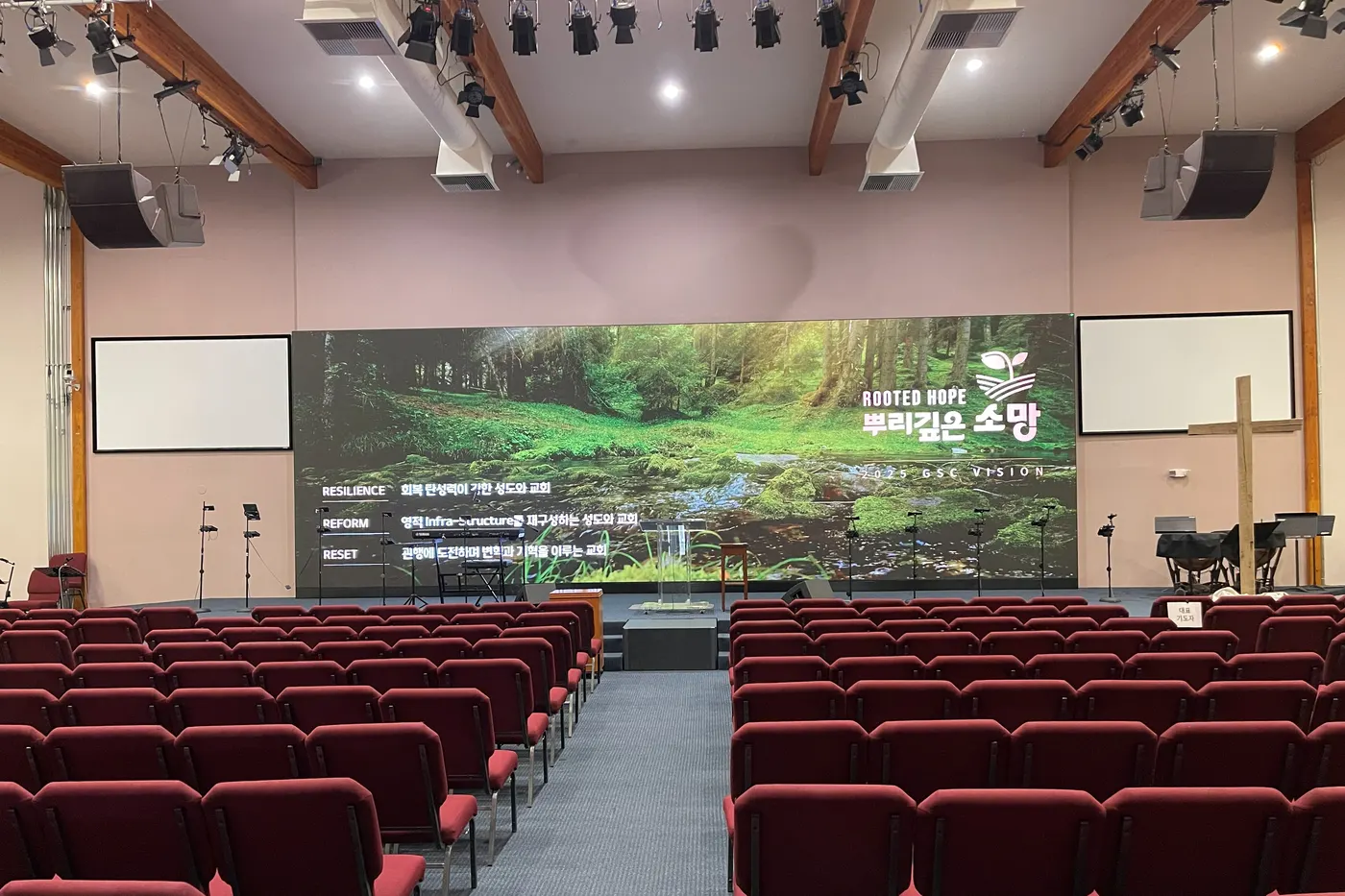
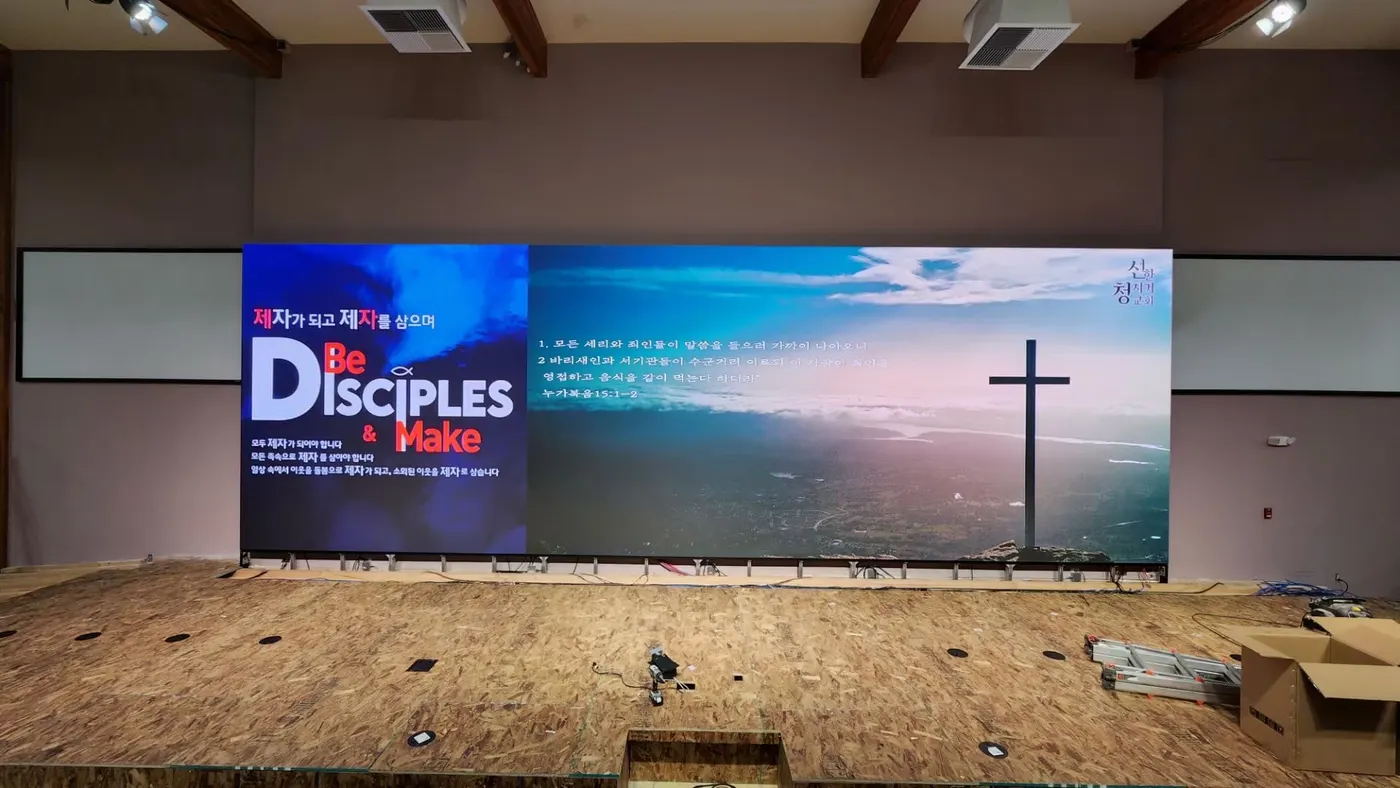
In August 2022, PixelPro Productions replaced the projection screens at Good Stewards Church in West Covina, California, with a 38 × 13 ft (11.52 × 3.84 m) P2.5 LED wall of 144 cabinets, driven by a NovaStar VX16s. The wall stands on an aluminium extrusion frame carried through the stage to the concrete slab, is flat to within 0.5 mm, and was installed between two Sunday services under California contractor licence #1063528.
At a glance
- Client
- Good Stewards Church (선한청지기교회), West Covina, California. A Korean-American congregation with its own English Ministry. gsch.org ↗
- Completed
- August 2022
- Display
- Gloshine Blade2.5 fine-pitch LED, 2.5 mm pixel pitch
- Size
- 144 cabinets (640 × 480 mm), 18 wide × 8 high. 11.52 × 3.84 m, about 38 × 13 ft
- Resolution
- 4608 × 1536, about 7.1 million pixels
- Weight
- Over a ton (about 1,020 kg / 2,250 lb)
- Processing
- NovaStar VX16s controller, NovaStar A5s receiving cards
- Flatness
- Within 0.5 mm across the whole screen, measured with a laser level
- Our scope
- LED wall, its frame and power; video system; camera system (same period); lighting (later phase)
- Warranty
- 3 years on the whole project
The brief
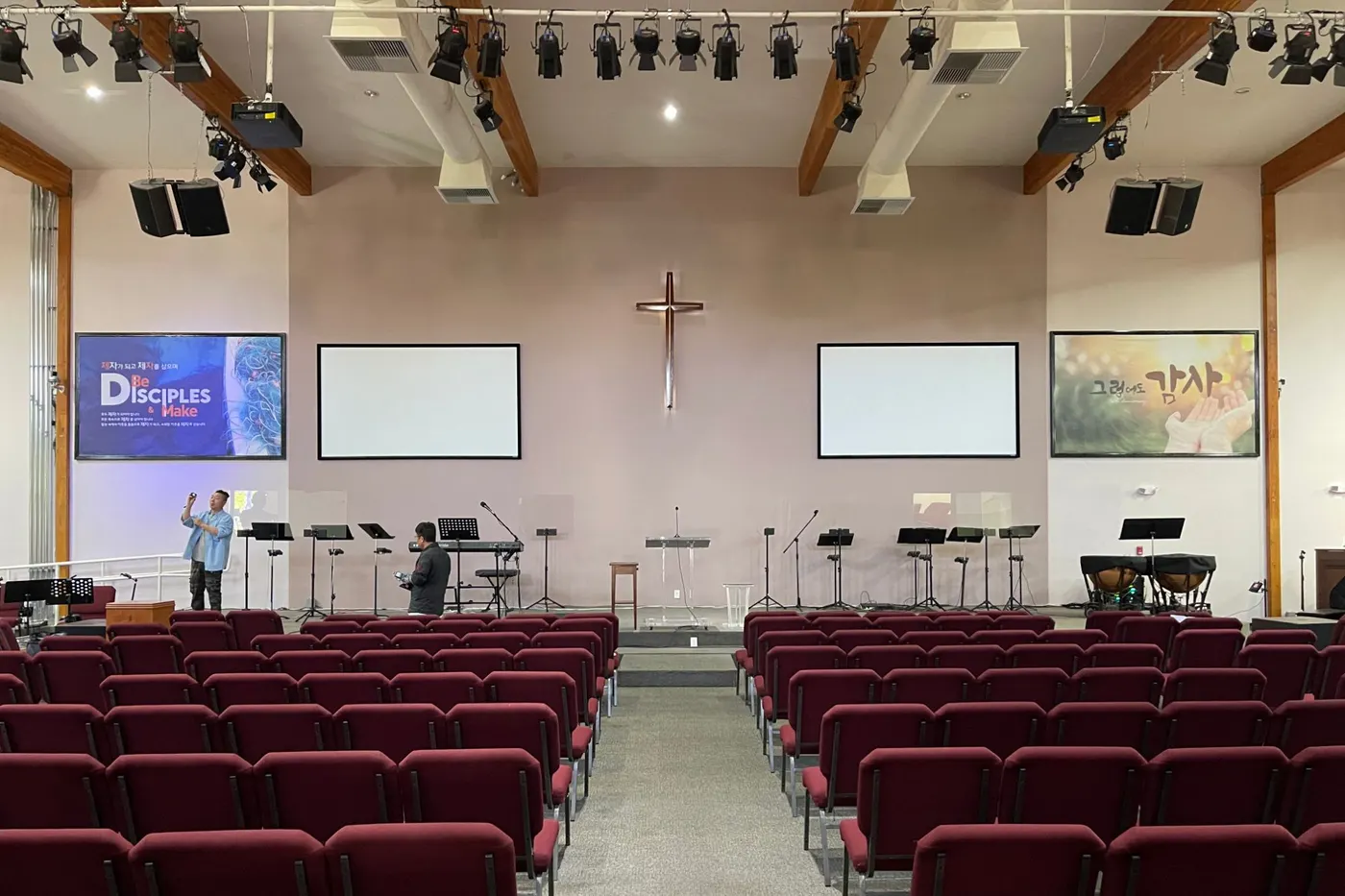
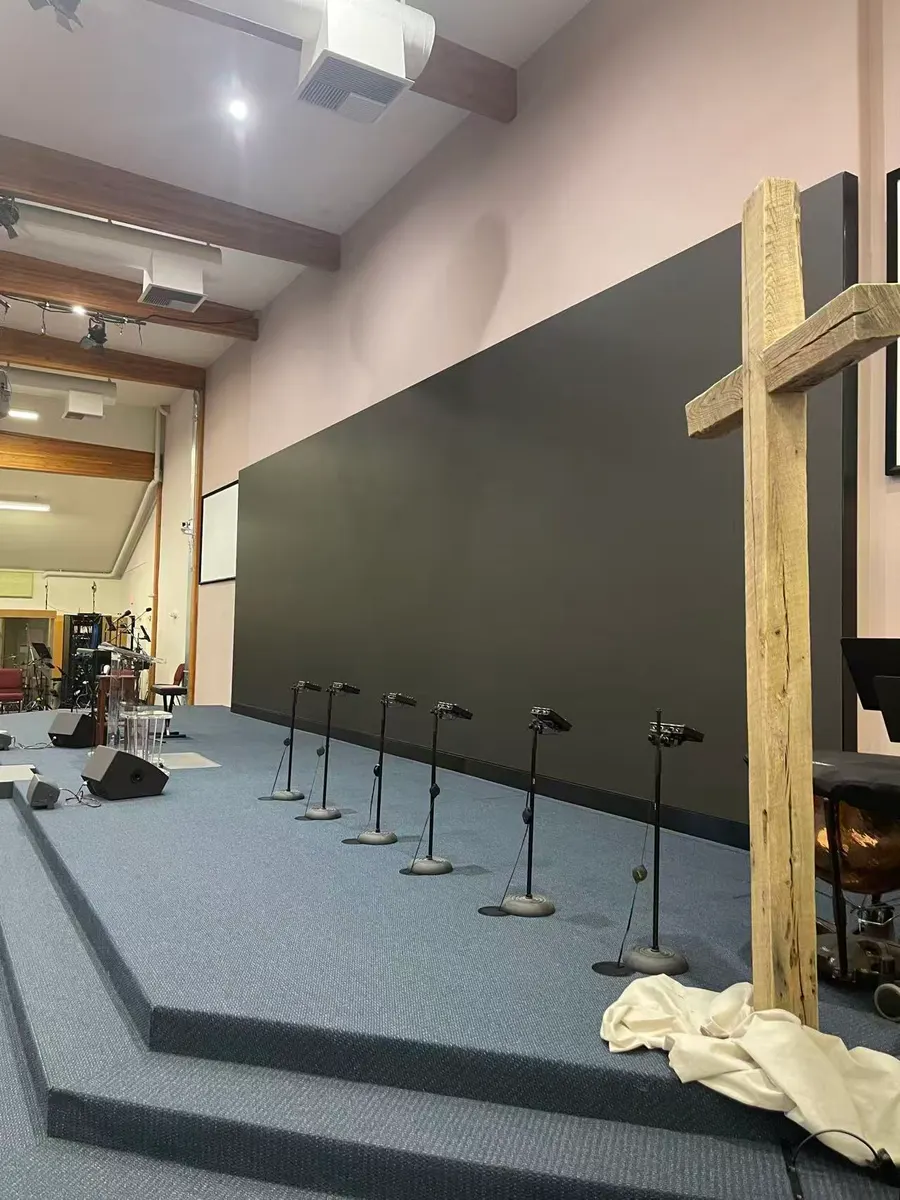
The stage wall held four separate pictures: a projection screen either side of the cross, and a printed banner beyond each. The church wanted one continuous LED wall.
Two things made the date non-negotiable. Sunday services could not stop. And on September 10–11 the church was hosting a hymn competition for its sister churches, where the new wall was meant to show the church at its best.
It started at a trade show
In April 2022, the church's senior pastor drove from Los Angeles to NAB in Las Vegas just to look at LED walls. Peter Lin met him at the Gloshine stand, beside a fine-pitch wall built for permanent installation. When the pastor learned we were based in Los Angeles and installed what we supplied, he invited Peter to visit the church.
The pastor later told Peter that of all the LED walls at the show, that one had the colour and picture he liked best.
Why that mattered
Most LED walls are bought on price per square foot. Careful buyers also match the pixel pitch. But two walls with the same pitch can look nothing alike: the LEDs, the circuit boards, the driver chips and the factory’s quality standards all differ, and all of them show on screen.
In a store, two TVs the same size can differ in price several times over, and you can see why by standing in front of them. LED walls from different makers almost never stand side by side before you buy. NAB was one of the few places the pastor could compare them, and he chose on picture, not on price.
A cheaper plan on the table
The church already had a contractor lined up, with a lower price and a plan to screw wood battens to the wall and mount the screen on them. Over a series of Saturday visits, Peter kept making one point.
A ton of LED hanging off a wall is not just a question of how flat it looks. In California, it is an earthquake question. The church changed its mind.
Eight versions, every Saturday
The church wanted to upgrade its LED, video, lighting and cameras together, which meant one plan for the whole room. That meant understanding what was already there and how the church actually worked, before proposing anything.
The elder leading the project had a full-time job and was only at church on weekends. So through the design phase, Peter Lin was there every Saturday: walking the room, opening the racks, watching how the team ran a service. The plan changed as the church’s thinking changed. It went through eight versions before the final design was signed off.
Challenge 01
A wall half an inch out of true, and a screen over a ton
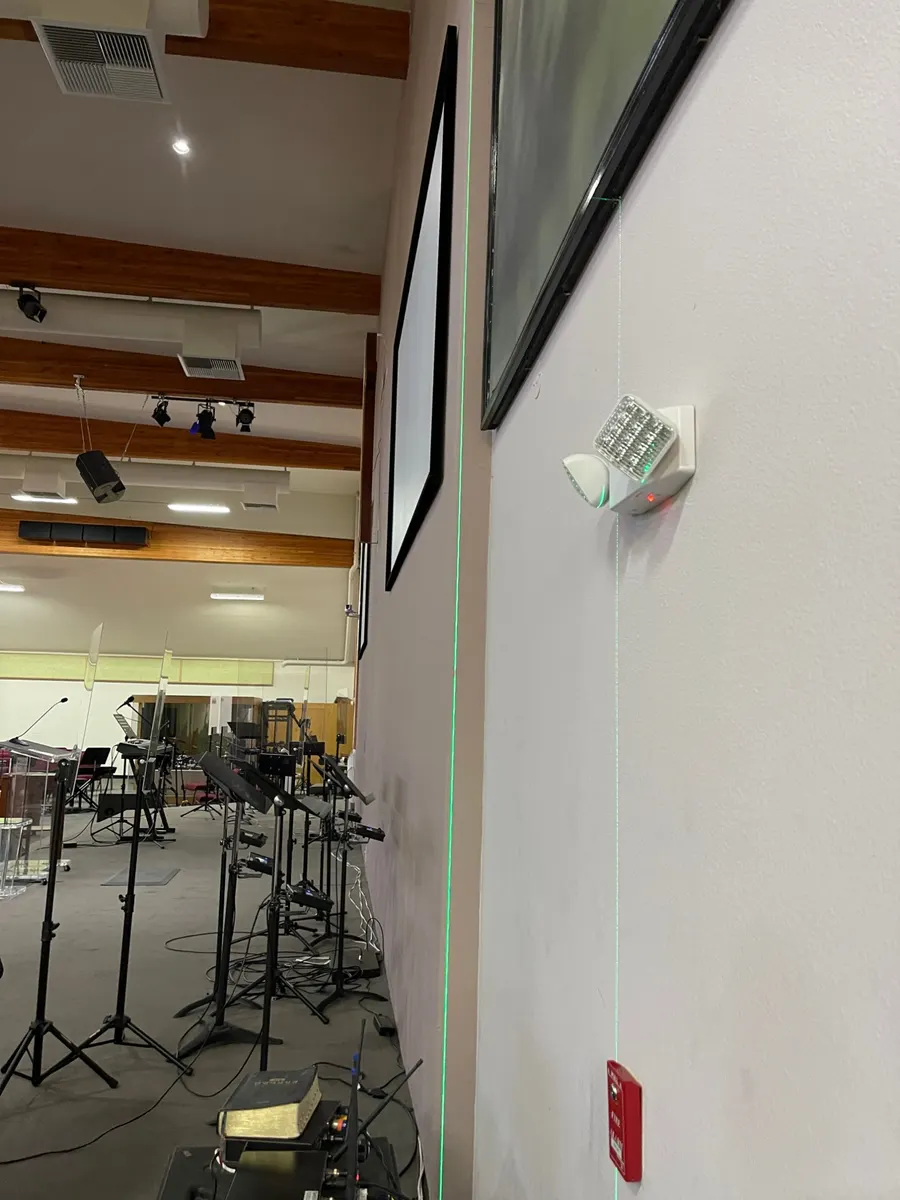
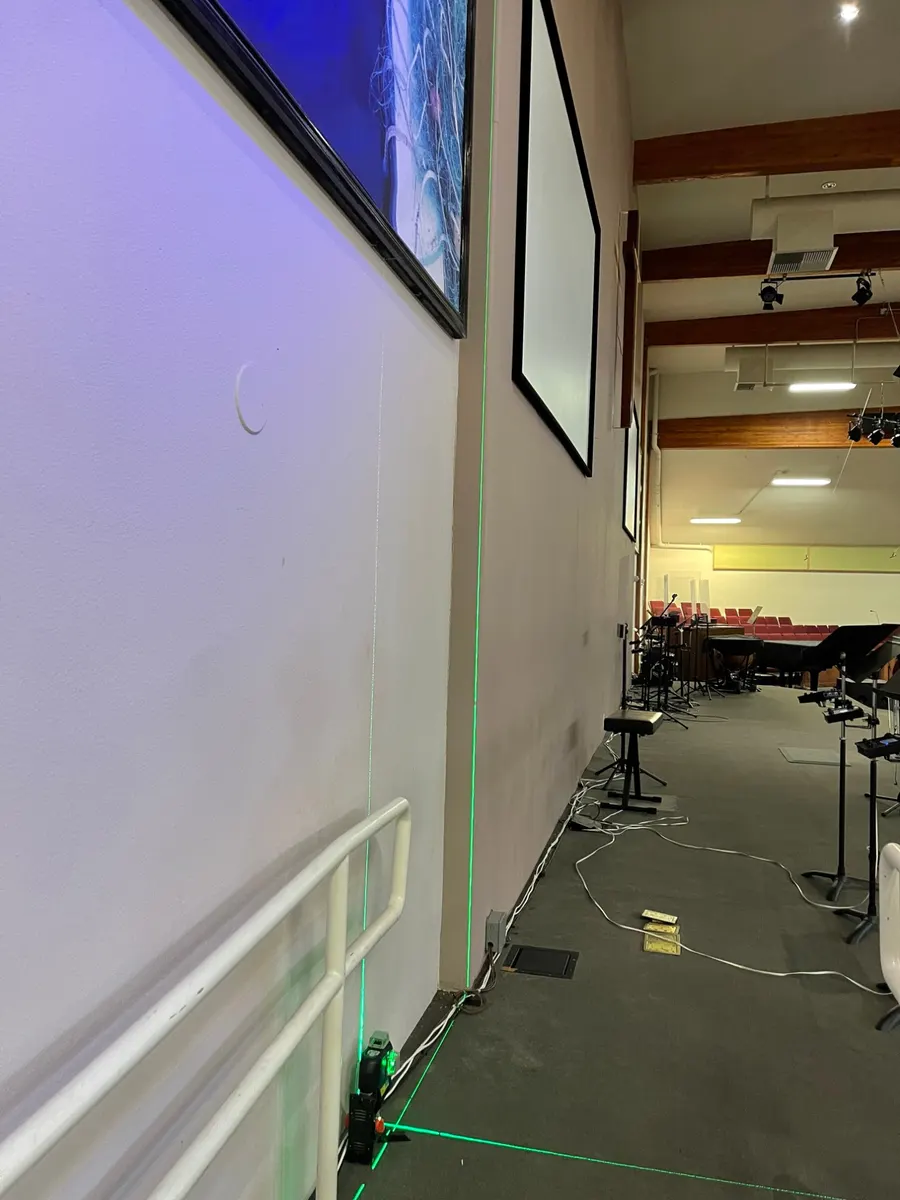
A laser survey of the stage wall found it half an inch out of plumb from top to bottom. The common approach is to fix wood battens or panels to the wall and screw the cabinets to them. That approach inherits every error in the wall, and 144 cabinets magnify it.
Weight was the second problem. The finished screen weighs over a ton. It should not hang on a wall that is out of true, and it should not sit on a stage deck either.
Peter’s call, as a licensed General B contractor, was to cut openings in the stage and carry the frame straight through to the concrete slab beneath. The structure stands on its own, independent of the wall and of the stage. This is the kind of structural decision an LED wall of this size requires, and it is why a General B licence matters for this work.
Challenge 02
Why aluminium, not wood or steel
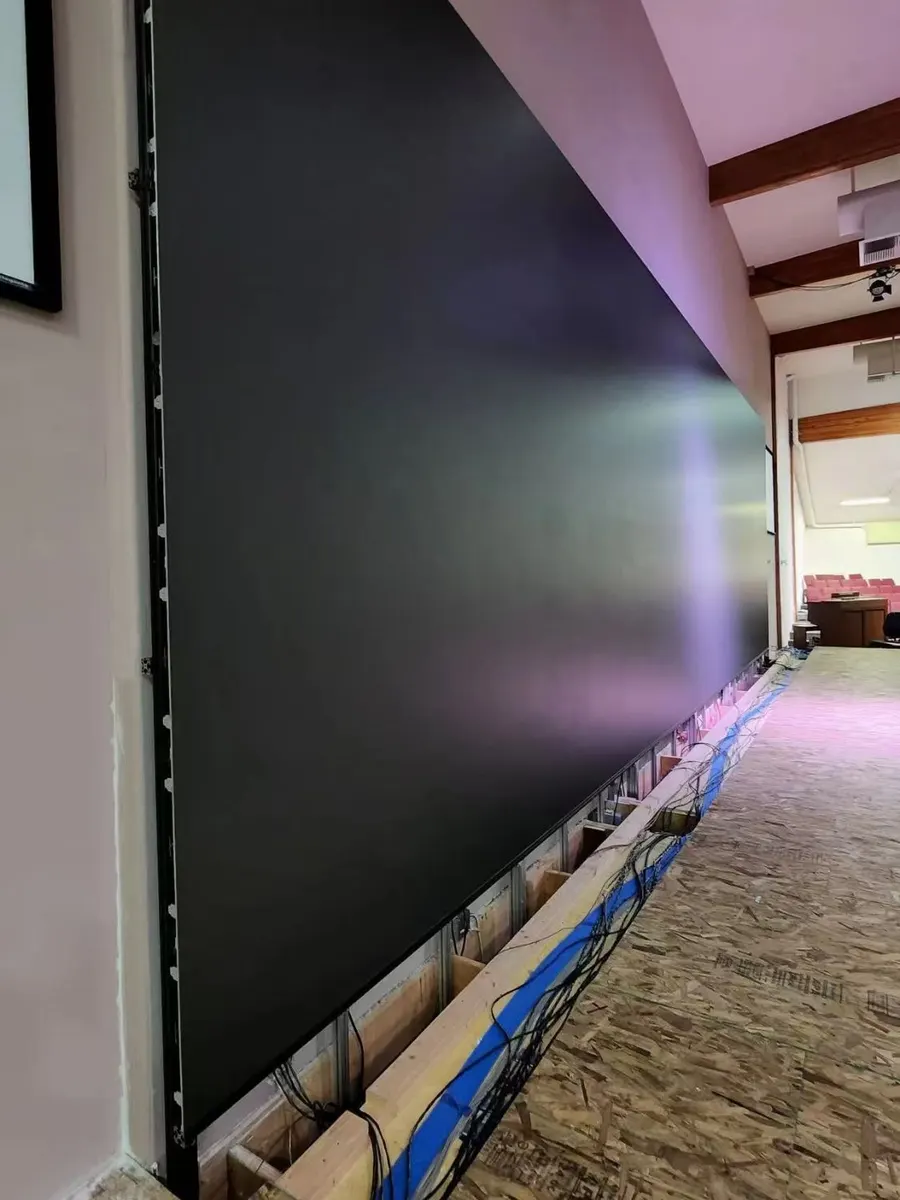
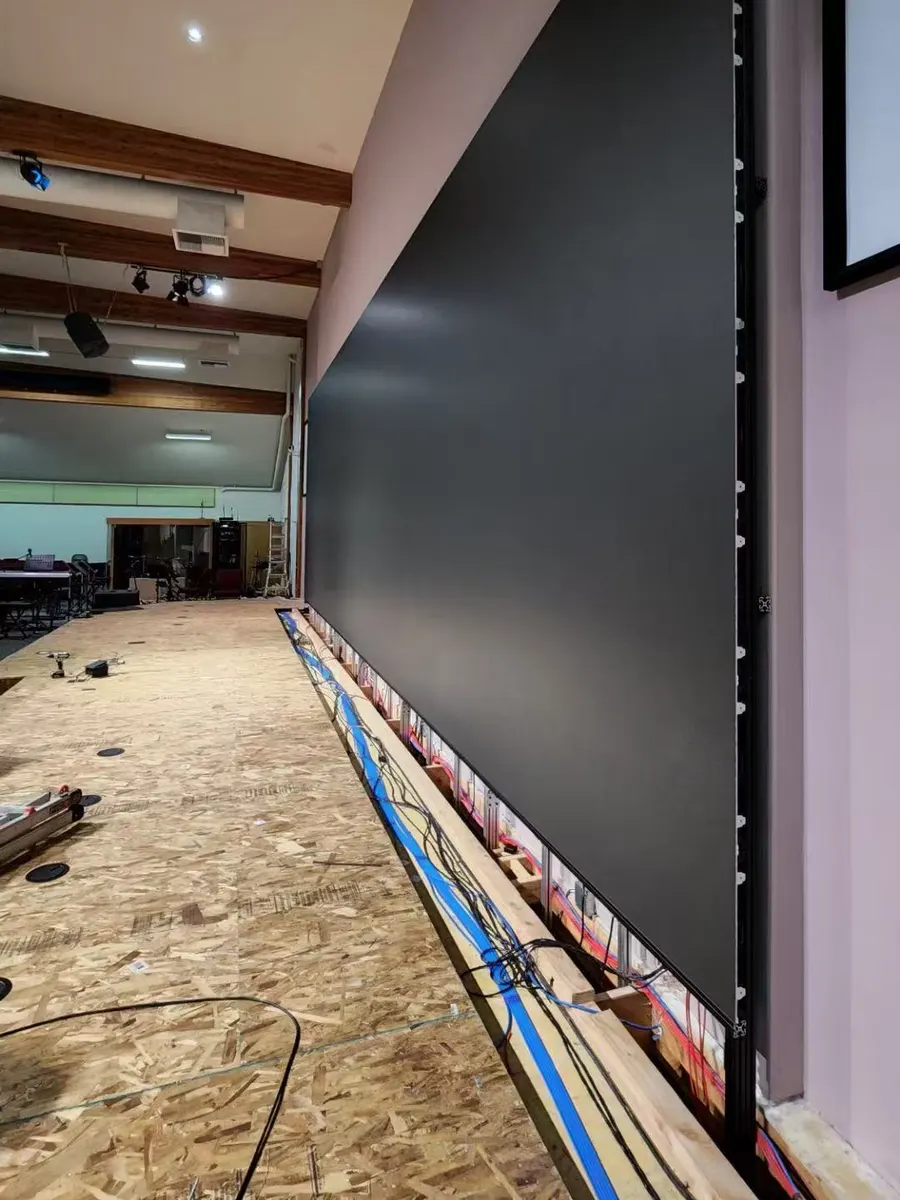
We built the frame from aluminium extrusion. It is light, dimensionally precise and easy to adjust, where wood moves and steel is heavy and hard to fine-tune.
Even so, the frame took three full days. That was the time it took to bring the whole mounting plane within 1 mm, horizontally and vertically, before a single cabinet went up. Our pass mark for the finished screen was 0.5 mm or better across all 144 cabinets, and the laser level confirmed it.
Challenge 03
Built once in the factory, then again on the wall
How an LED wall looks depends as much on how it is installed as on what it is made of.
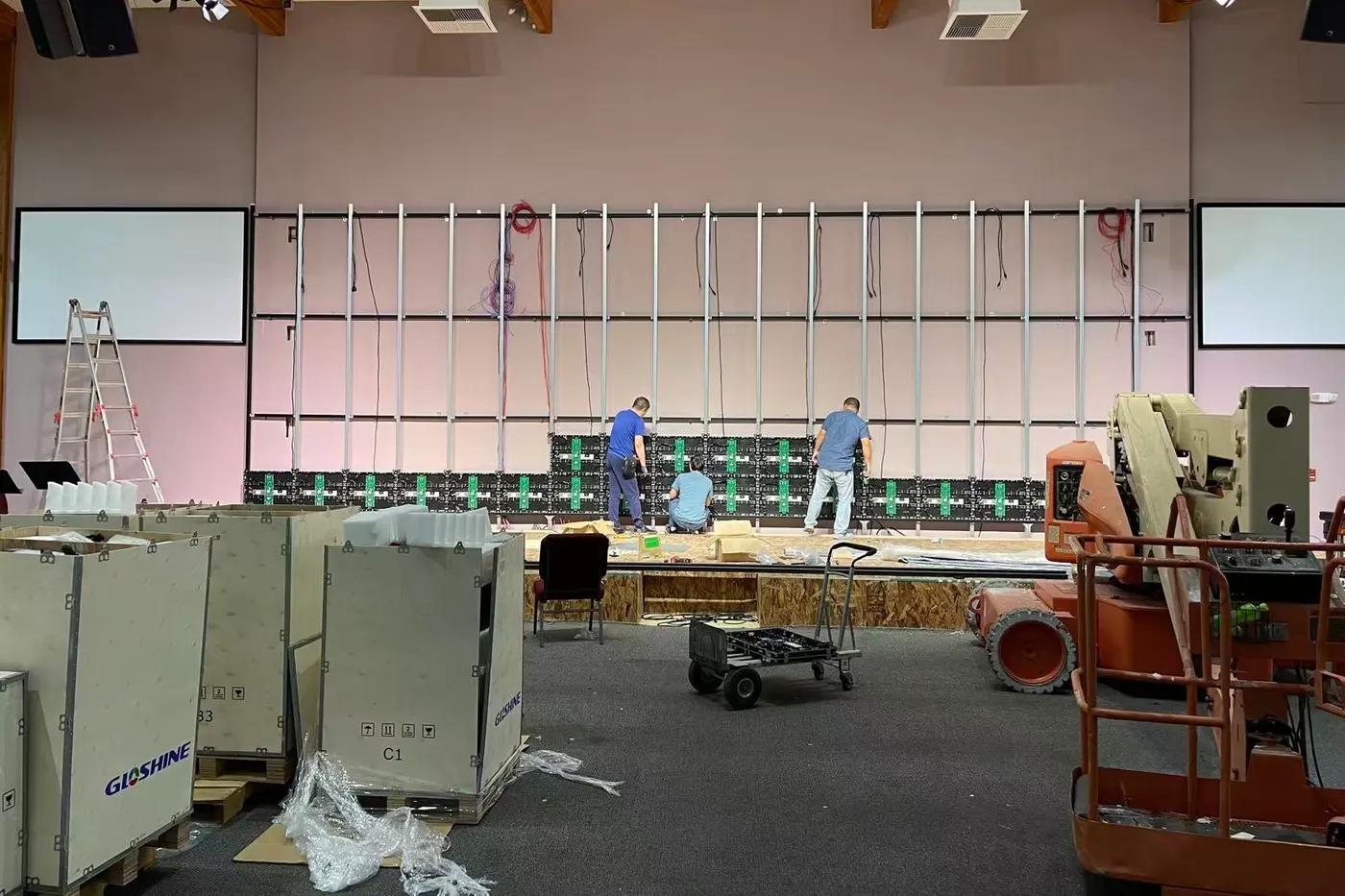
Before it shipped, the whole wall was assembled at the Gloshine factory at the church’s exact dimensions, run through a burn-in, and given a NovaStar full-screen calibration. Every cabinet and every module was then numbered, and on site each one went back in its calibrated position. That is what keeps the colour even from one edge of a 38-foot wall to the other.
The three days spent on the frame made the rest possible. With the mounting plane already within 1 mm, our engineers adjusted each cabinet and each module by hand until the surface was flat to 0.5 mm. That was the standard Peter committed to when the contract was signed.
Most quotes carry a single line for “LED installation”. They rarely say to what standard, or with what result, and few buyers know to ask. We write it down, because our work comes to us by word of mouth.
Challenge 04
Moving the control room without rewiring the building
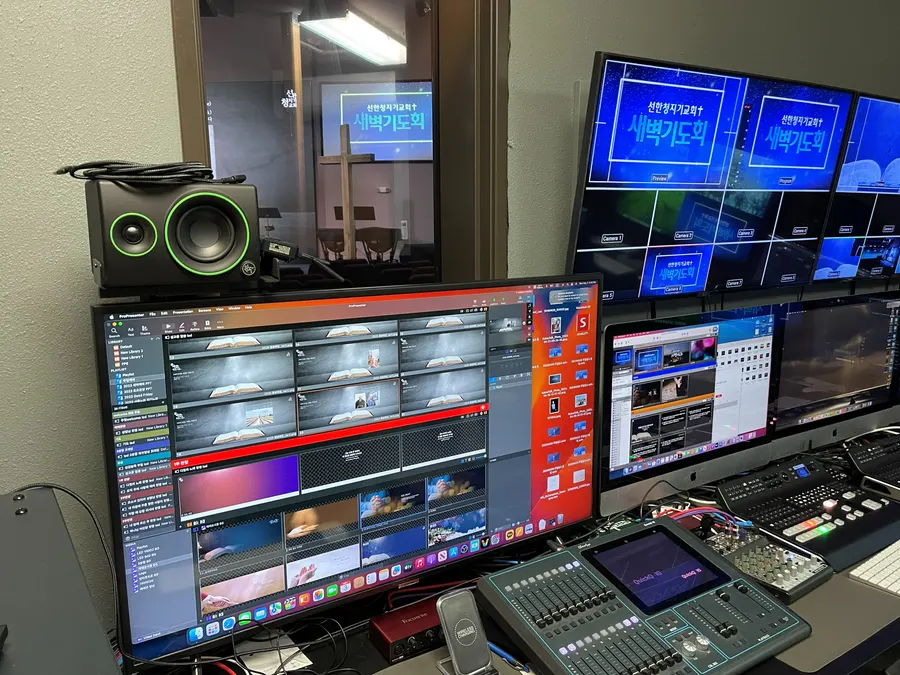
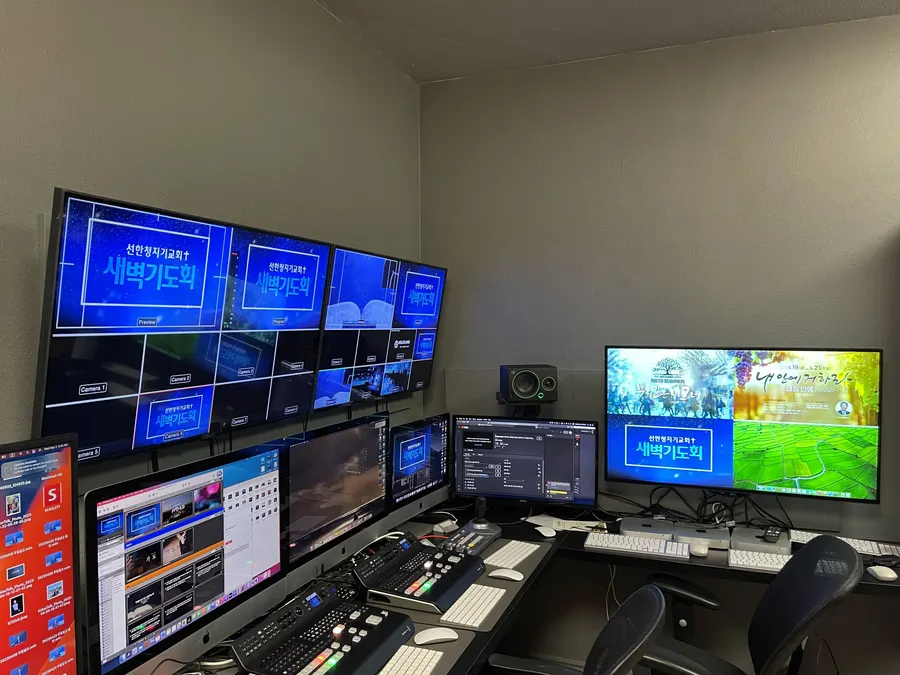
The retrofit moved the video control room to the other side of the room. All the existing video cabling ran to the old control room, and pulling it all again would have been expensive. The job was to keep every function the church needed while re-running as little as possible.
- The projectors stayed. The church’s two projectors and screens moved to either side of the new LED wall, where they now serve as supporting displays.
- The cameras stayed, and got a better backbone. Every camera got a new 12G-SDI and Cat6 run to the new control room. That fixed the problems in the existing HD system and puts the cabling in place for a future move to 4K.
- Mixed brands, mixed years. After the wall went up, every camera, each from a different brand and year, was reinstalled and commissioned into the new system.
- The prayer rooms. Several prayer rooms each have their own TV, fed by HDMI cable concealed during an earlier renovation. We placed an HDMI-over-network transmitter and switcher in the old control room to feed those cables from the new one, without opening a wall.
None of this shows up as a line item on a contract. All of it saved the church money.
Challenge 05
A 208 V power design, through the building’s own conduit
After surveying the church’s electrical service, we recommended a 208 V supply for the wall. That halved the power cabling, and with half the cable we could use conduit the building already had in place, which saved cost, labour and time. We added a 70 A breaker to the existing 100 A panel in the control room and a new sub-panel at the video wall.
There were no original drawings. Finding the existing conduit came down to construction experience, the General B side of the job again.
Challenge 06
Finished edges nobody asked for
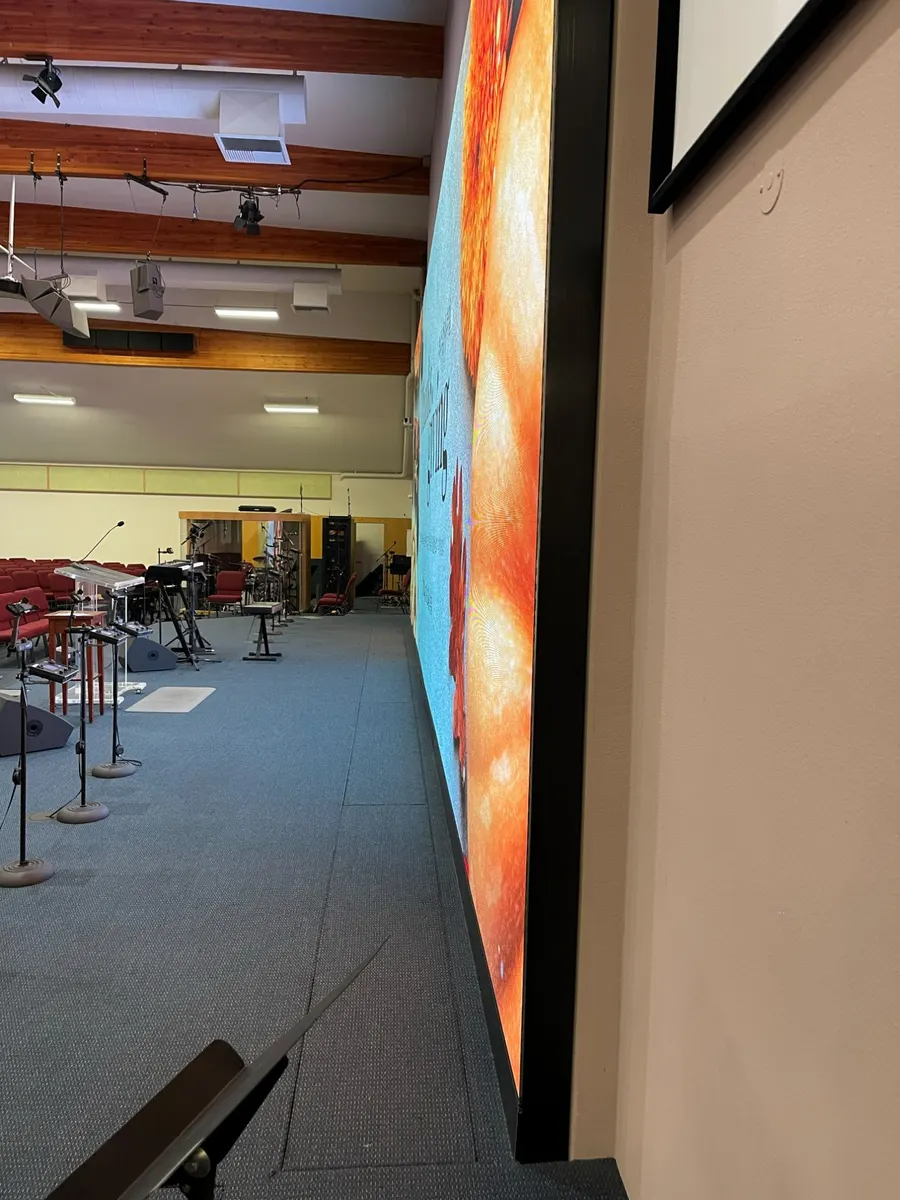
The wall is framed on both sides and along the bottom in aluminium trim cut to the room’s exact dimensions. Trim that long takes time to make and ship, so we ordered it the day the design was approved, and it arrived with everything else. It was not in the contract, and the church had not thought to ask for it.
Timeline
- April 2022The senior pastor meets Peter at NAB, Las Vegas
- Late April–MaySaturday site visits; eight design revisions
- June 3, 2022Contract signed; LED and custom trim ordered
- Aug 11–12Control room power and projector work
- Mon, Aug 15LED wall delivered
- Aug 15–17Aluminium frame built and levelled (3 days)
- Aug 17–19144 cabinets installed
- Aug 19–20Screen configured
- Sun, Aug 21First Sunday worship on the new wall. The stage carpet wasn’t even down yet.
- Aug 22–23Video system configured, team trained, handover
- Sep 10Competition rehearsal, on site
- Sep 11Hymn competition, supported on site
The result
- Not a single Sunday service lost during the works.
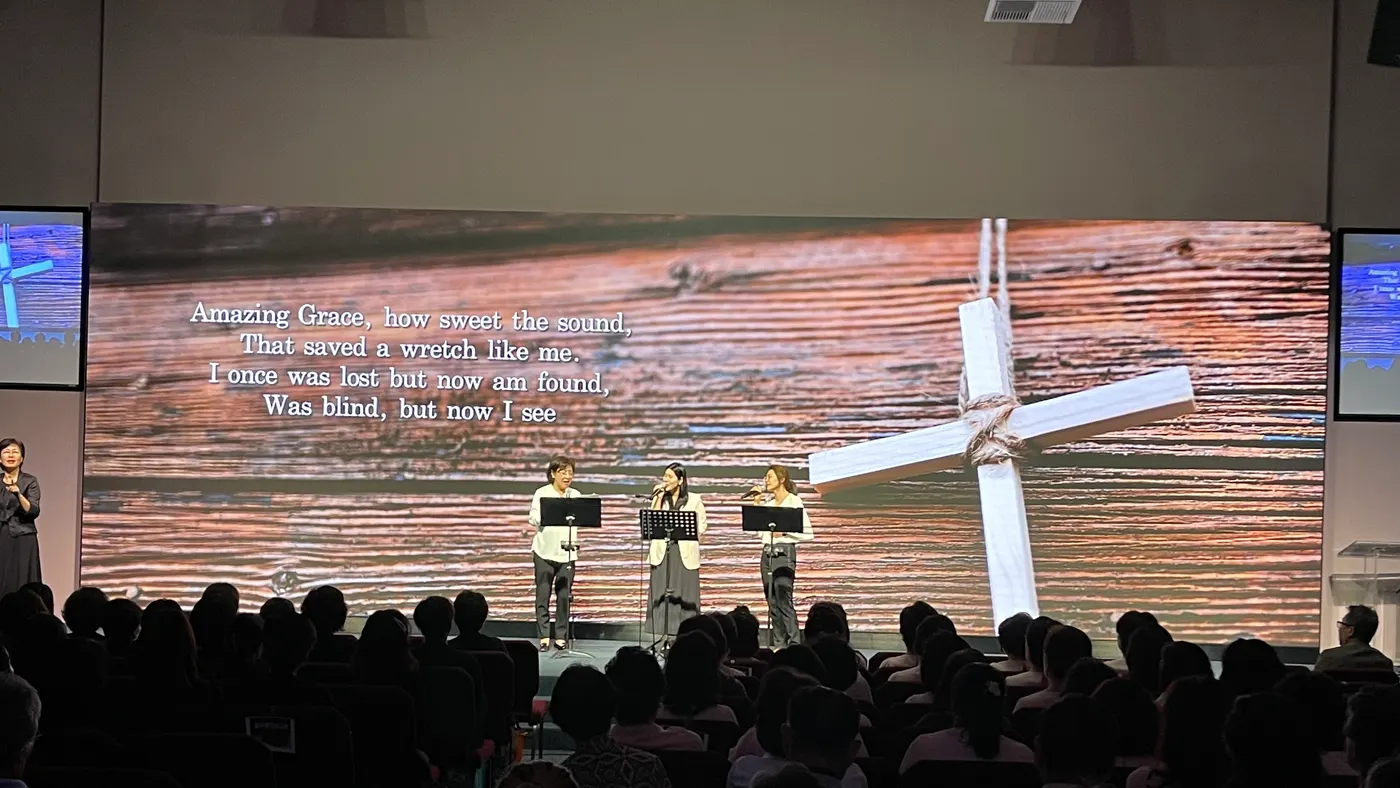
- In worship use six days after delivery, and still in use every week (photographed in 2025).
- Handed over two and a half weeks before the hymn competition.
- The existing projectors, screens and cameras were kept and re-used.
- Flat to within 0.5 mm across a 38-foot wall.
- The church came back to us for a later lighting upgrade.
- When a church in Irvine asked Good Stewards about us, Elder Chang took the call. That church became our next client.
Go for it, they are the best!
Questions churches ask
How long does it take to install an LED wall in a church?
At Good Stewards Church the 38 × 13 ft wall went up in six days, Monday to Saturday: three days to build and level the aluminium frame, then the 144 cabinets, then configuration. It was delivered on a Monday and used for worship that Sunday. The longer part of the schedule is before that: the equipment took about ten weeks from order to delivery, and the design went through eight revisions before it was signed off.
Can a church keep holding services while the LED wall is installed?
Yes. We plan each install to fit inside one week, and when it cannot, the work is staged so the sanctuary is usable at every Sunday milestone. At Good Stewards Church not a single Sunday service was lost; the new wall was in use the first Sunday after delivery, before the stage carpet was even laid.
Why not mount an LED wall on wood battens fixed to the wall?
Because the screen can only be as flat as what it is fixed to, and most walls are not flat. The stage wall at Good Stewards Church was half an inch out of plumb, and the finished screen weighs over a ton. A wall that is out of true, or a stage deck, is the wrong thing to carry that weight in California, where it is also an earthquake question. We built an aluminium extrusion frame instead and carried it through the stage to the concrete slab.
How flat should a church LED wall be, and how is it checked?
Our pass mark on this project was 0.5 mm or better across all 144 cabinets, measured with a laser level. The frame was levelled to within 1 mm before the first cabinet went up, then each cabinet and module was adjusted by hand. The wall was also assembled and calibrated at the factory, and every cabinet and module was numbered so it went back in the same position on site.
Can we keep our existing projectors and cameras?
Often, yes. At Good Stewards Church the two projectors and screens were moved to either side of the LED wall as supporting displays, and every camera was kept, reinstalled and given new 12G-SDI and Cat6 runs to the new control room, which also prepares the church for a future move to 4K.
Does a church LED wall need a licensed contractor in California?
An LED wall of this size involves structure and line-voltage power, which is construction work under California law. PixelPro Productions holds CSLB licence #1063528 (class B, General Building). On this project that licence covered the decision to anchor the frame to the concrete slab and the 208 V power design routed through the building’s existing conduit.
We design and install LED walls like this across Southern California: structure, power and control, from one licensed contractor. LED video wall design and installation →